Transformation performance
AudienceTransformation leaders and initiative owners
Contextual guidance for transformation leaders and initiative owners working through priorities, obstacles, and momentum.
Led experience strategy and experimentation across three GenAI initiatives, exploring how contextual coaching could bring specialized expertise closer to transformation decisions and action.
3
GenAI initiatives
6 months
From opportunity framing through prototyping and validation.
Enterprise context
Developed within a global capability-building portfolio.
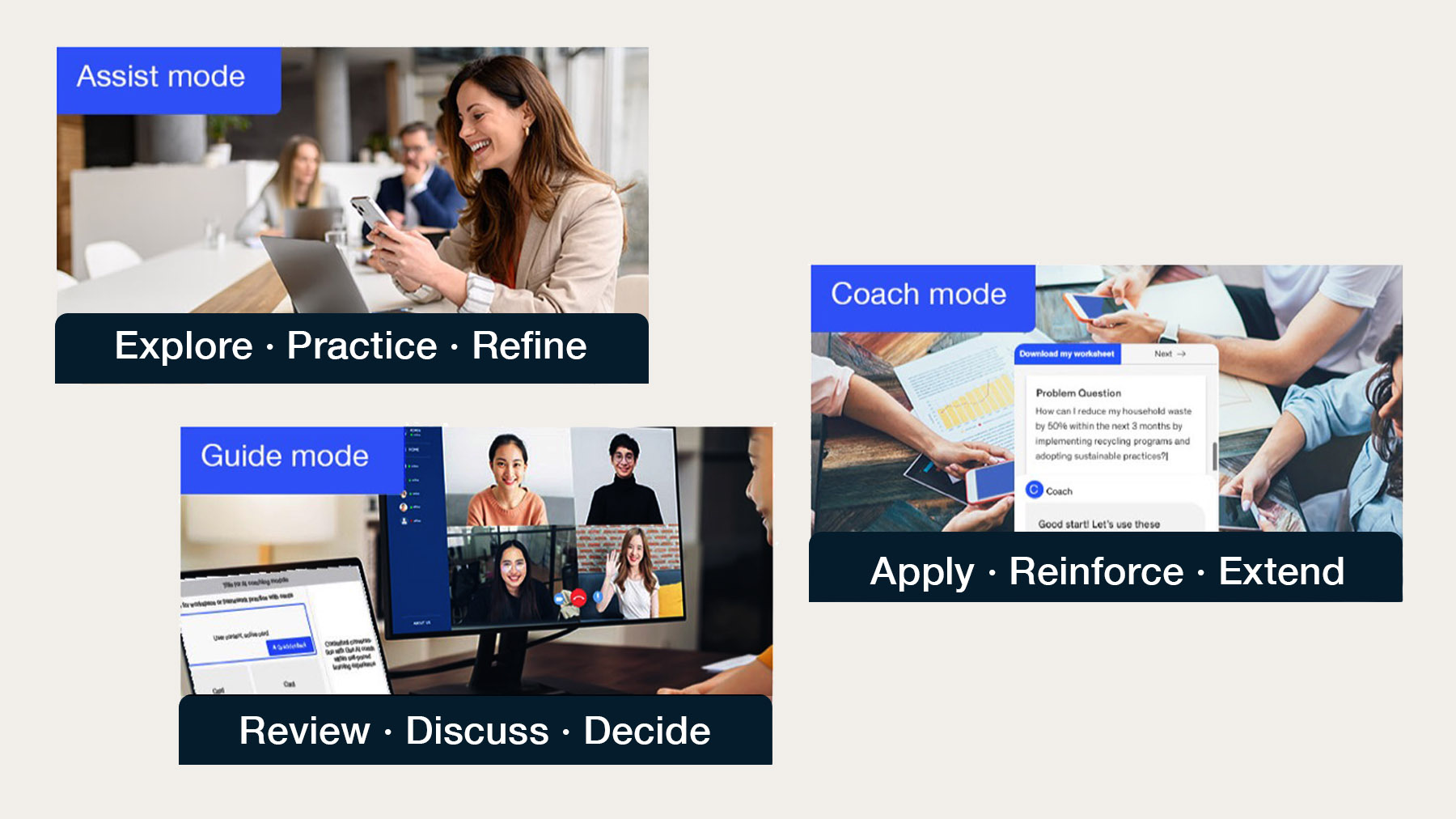
Visual note — Project visuals are illustrative. Selected artifacts have been adapted, recreated, or sanitized to protect confidential and proprietary information.
I was part of the McKinsey Academy team as the platform reached more than one million participants across 3,000 organizations in 80 countries. My work explored its next evolution: using GenAI to make coaching and performance support more contextual and closer to the work itself.
Platform figures publicly reported by McKinsey Academy in 2024.
Transformation asks leaders to make decisions amid ambiguity. Expertise was available, but conventional learning could not always support judgment at the moment of action.
GenAI created an opportunity to provide contextual coaching while preserving client ownership of the transformation.
How might GenAI bring relevant expertise and coaching to the decisions that move transformation forward?
The work explored how AI could support people before, during, and after consequential moments of action.
AudienceTransformation leaders and initiative owners
Contextual guidance for transformation leaders and initiative owners working through priorities, obstacles, and momentum.
AudienceManagers and leaders
Practice and coaching that helped managers apply problem-solving and leadership capabilities to situations in their work.
AudienceSenior leaders and founders
Guidance for senior leaders navigating unfamiliar technology decisions while retaining judgment and ownership.
I led the experience strategy and quality approach, partnering with engineers responsible for model development and fine-tuning.
Framed the opportunity for contextual coaching
Identified where GenAI could bring specialized knowledge closer to transformation decisions. Worked with stakeholders and subject-matter experts to translate leadership, learning, and performance goals into experience opportunities.
Turned opportunities into testable hypotheses
Defined hypotheses, success measures, prototypes, and validation requirements so evidence could guide investment and scaling decisions.
Shaped the AI experience and its quality framework
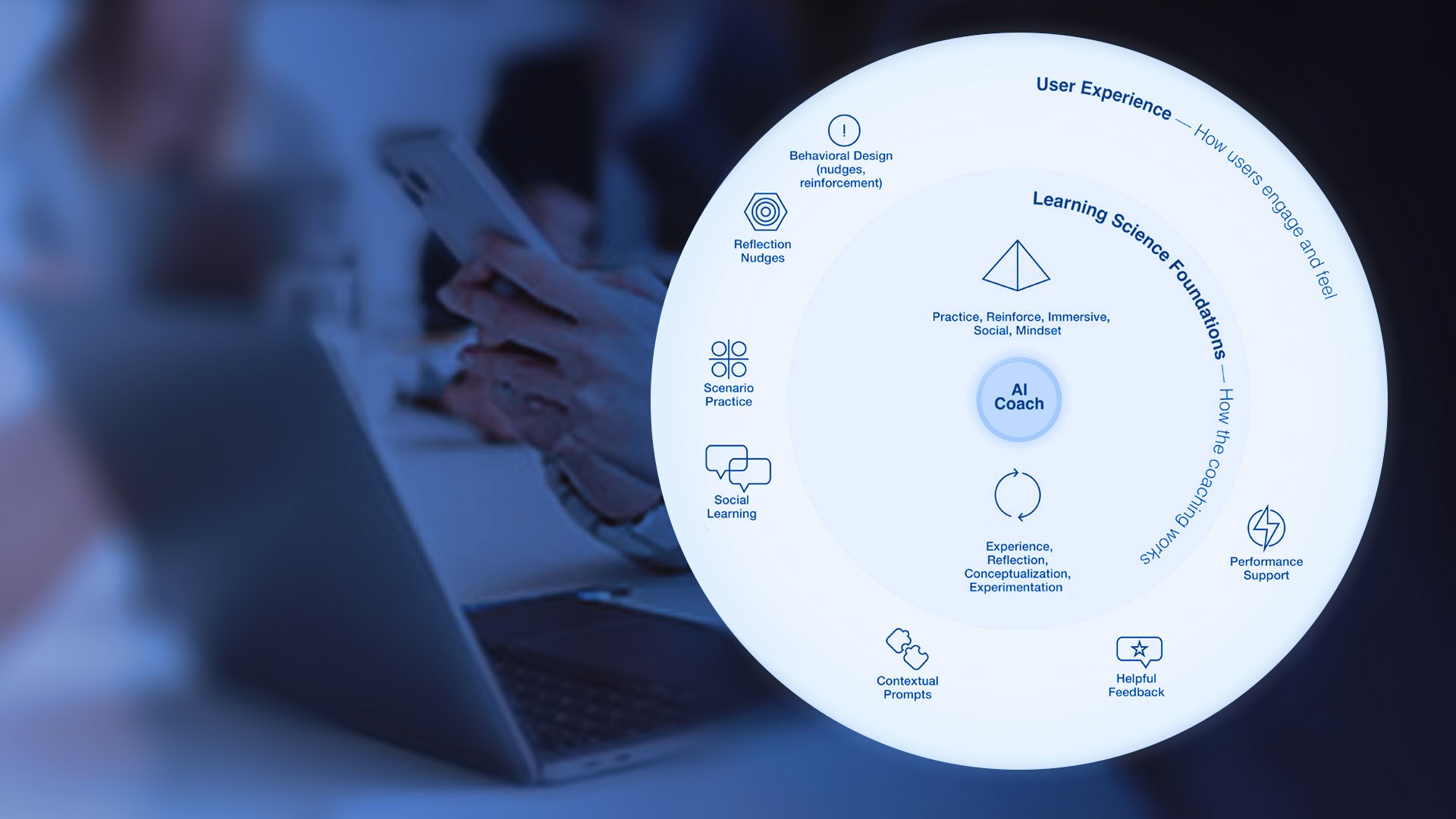
Led experience strategy across conversational flows, coaching behavior, RAG interactions, prompt engineering, personality and tone, accessibility, and responsible-AI guardrails. Partnered with engineers on response evaluation, model-risk review, and experience QA as the underlying models were fine-tuned.
Embedded reusable practices across teams
Extended design and brand systems for AI-enabled experiences and created reusable frameworks for prompting, evaluation, QA, and cross-functional collaboration. These practices helped integrate design throughout the development lifecycle.
Methods & disciplines
Bring coaching into the work
The opportunity was not another content destination. GenAI could provide relevant guidance as people interpreted situations, made decisions, and acted.
Design for judgment, not instruction
The experience needed to support reflection and informed action without replacing client ownership or prescribing the answer.
Use experimentation to reduce uncertainty
Translated the concept into hypotheses, prototypes, and success measures so evidence could determine what advanced, changed, or stopped.
Build capability alongside the products
Each initiative also established reusable patterns for interaction, coaching behavior, validation, and risk mitigation.
Where contextual coaching can support transformation
| Mobilize | Execute | Embed | Sustain | |
|---|---|---|---|---|
| Transformation need | Establish direction | Move initiatives forward | Apply new practices | Maintain momentum |
| Coaching role | Clarify priorities | Support decisions | Prompt practice and reflection | Reinforce learning and adaptation |
| Progress signal | Shared direction | Clear ownership | Regular action | Sustained use |
This table represents my design reasoning; no client information or production data is shown.
Within six months, three GenAI initiatives advanced from opportunity framing into experience design, prototyping, and validation. The work made contextual coaching tangible while establishing reusable direction for subsequent AI initiatives.
70%
Faster time to capability
Managers became ready to apply problem-solving sooner. Problem-solving pilot versus learning without the AI coach.
More, better
Initiatives in bottom-up planning
Planning received more and better-quality initiatives. Initiative quality was an observed signal.
3 initiatives
Advanced across distinct transformation contexts.
6 months
From opportunity framing through prototyping and validation.
Reusable patterns
Interaction, coaching behavior and guardrail principles established across workstreams.
Team capability
Shared experimentation and AI-design practices created for subsequent initiatives.